Discrimination in 1800s Chicago
Ever look at an old newspaper and realize history is just a bunch of people shouting at each other to get it together?
I found this Polish newspaper clipping from 1912, right here in Chicago. It’s a fiery editorial written by an immigrant who is absolutely furious at his own community. He feels that the Bohemian and Irish have too much pull, leaving the majority Polish community feeling like second-class citizens.
The article is from a place called the “Town of Lake.” If you know Chicago history, that’s the massive independent township annexed into the South Side back in 1889—right where the legendary Union Stock Yards were. Today, the address 4840 South Paulina is the heart of the Back of the Yards neighborhood.
By 1912, this area was a brutal, industrial melting pot. It’s the exact setting of Upton Sinclair’s famous book, The Jungle, which exposed the meatpacking industry through the eyes of newly arrived Lithuanian immigrants.
But this Polish writer is mad. Why? Because the newer immigrants—the Poles and the Lithuanians doing the hardest labor in the stockyards—felt like second-class citizens. They were completely shut out of power.
The author screams, “What kind of aldermen do we have? An Irishman and a Czech!” He slams his fellow Poles for being “naive” and avoiding their own people. He says they’re flocking to Czech banks, buying from German warehouses, and paying fat legal fees to Irish and German lawyers right under their noses, instead of supporting Polish businesses.
He ends the piece with a massive battle cry: “Solidarity, and once again, solidarity!” It’s a wild look at how these neighborhood lines were drawn, the intense rivalries between the Irish, Czechs, Poles, and Lithuanians, and the grind of trying to make it in Chicago over a century ago.
This area is covered between today’s 39th Street and 87th Street, from State Street to near Cicero Avenue (other sources say to Western Avenue, and Wikipedia says Pulaski.
Auburn Gresham, Englewood, and other neighborhoods are standing in an area that had ethnic diversity that discriminated against one another. There was ethnic and family unity in one aspect of the area, but then there was lawlessness and prejudice towards other cultures that spoke different languages and waved different flags.
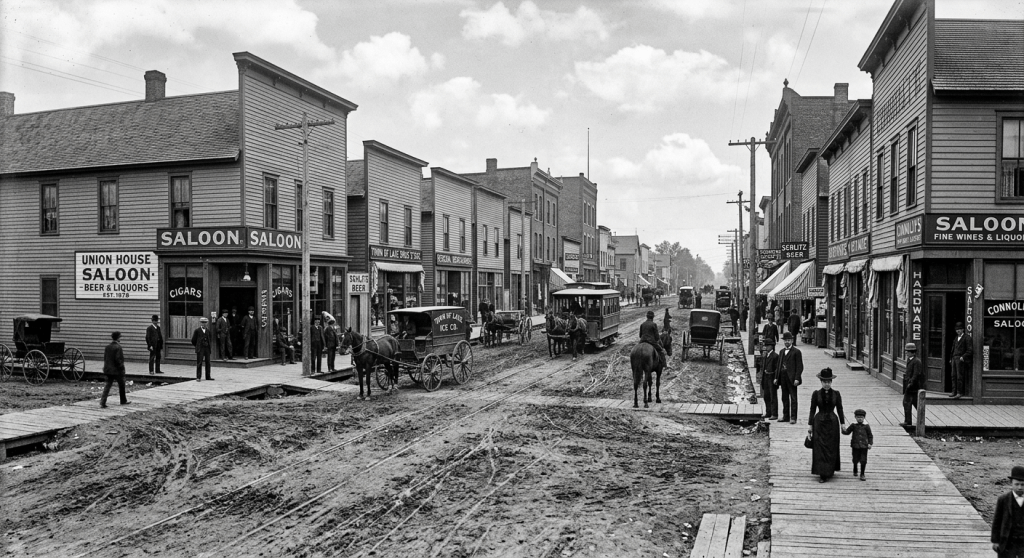
In 1891, on April 1st, towards the west side, Rev. Hensen(called sensationalist Hensen) spoke at a church, calling the bars and drunks there to be similar to vampires sucking the blood out of politics and civility. A lot of people pushed votes at saloons in those days. He called them hell-holes. He says “that they hang the anarchist who throws bombs, but at the same time elect the same type of anarchist that comes from those hell holes to become an alderman or a saloon keeper. He said, “that all the good conspiracies against law, good order, peaceful social relations, and good municipal administrations are hatched in the low saloons”.
When Elmer Washburn was running things in “Town of Lake”, there were about 500 saloons in the vicinity. Elmer had some power similar to that of a Mayor in the “Town of Lake”. People criticized him for letting the drunks do whatever they wanted to do. The saloons were open 7 days a week, and many people felt ill about that, since Sunday was a holy day for them, for family, not for a saloon. The saloons would stay open all night as long as there were customers, the place stayed open. Just imagine the type of community where everyone got together at their favorite saloons, and where fights, drunkenness, and houses of ill repute were part of the nightly fashion.
Years before the wild times in the Town of Lake, Mayor Roche in Chicago drove out a lot of gamblers and drunks. A lot of those people came to the Town of Lake. What started out as a peaceful community of German and Dutch truck farmers turned into some wild times by the end of the 19th century.

 The Essence of Chicagoland Areas